History
Milestones & Memories
Take a look at some of the memorable moments that made the club what it is today.

The Club is Established
Officially founded in 1889, the club began operations in a modest facility at 923 Walnut Street, featuring two dedicated rackets courts and Philadelphia’s first regulation squash singles court. This marked the beginning of RCOP’s rich tradition in racquet sports and set the stage for the innovations that would follow.

The New Clubhouse is Built
Under the leadership of George D. Widener, the current clubhouse on 16th Street is built, designed by renowned architect Horace Trumbauer featuring the world’s first above-grade swimming pool, engineered by Roebling Construction Company.

The Invention of Doubles Squash
In 1907, Racquet Club pro Fred Tompkins repurposed an unused space to create the first squash doubles court. He refined the game, laying the foundation for its growth. Today, his innovation has spread worldwide, with over 200 courts and a thriving community of passionate players.

Olympic Dreams
When 1908 Olympics took place in London, the host country was able to hand pick several sports for inclusion. As primarily British sports, both Court Tennis and Rackets were selected (the only year they received that honor) and were contested at the Queen’s Club in West Kensington. While the British swept the Racquets event winning gold, silver, and bronze in both the singles and doubles, in the Court Tennis singles prominent RCOP member Jay Gould took home the gold.

Tragedy Strikes Aboard the Titanic
Three esteemed club members George D. Widener, his son Harry Elkins Widener, and John B. Thayer Jr. perished in the tragic sinking of the RMS Titanic. John Thayer Jr.’s son, Jack Thayer, survived and later served as RCOP president from 1941–1945.

A Toast in Secret
Though the club maintained public compliance with Prohibition laws, the reality behind closed doors told a different story. Members discreetly rented liquor lockers surrounding the basement bar near the grille. The club’s beloved oysterman, Charley, also served as its unofficial bootlegger, selling whiskey at a dollar a pint—after purchasing it for just thirty-two cents. Charley quietly amassed a small fortune from the club’s loyal patrons.

The Philadelphia Eagles Are Born
Club member Bert Bell, along with fellow RCOP enthusiasts, played a pivotal role in persuading the NFL to revive the defunct Frankford Yellow Jackets franchise under a new name: the Philadelphia Eagles. Bell served as the team’s president, and early team workouts were held on one of RCOP’s rackets courts. The Eagles played their first game against the New York Giants in 1933, and won!

Doubles Nationals
Squash doubles quickly gained popularity, leading to the first U.S. National Championships in 1933. Professional doubles followed in 1938, and by 1981, the World Doubles Championship was established. Today, the sport boasts 10,000 players in the U.S., competitive leagues in major cities, and a vibrant international tournament scene.

Architectural Recognition
The clubhouse is added to the National Register of Historic Places, recognizing its architectural and historical significance.

A New Era for Squash
Thanks to a generous gift from Shanin and Tracey Specter, the club completed the construction of three new squash courts on the second floor. This expansion further solidified RCOP’s status as Philadelphia’s premier squash destination, providing state-of-the-art facilities for players of all levels.

130th Anniversary
The Racquet Club celebrated its 130th anniversary with a memorable dinner taking over the entire first floor of the club. Members gathered to honor the club’s community while enjoying a formal evening with live music and dancing. We look forward to the next 130 years of sport, community, and unforgettable moments.


Our Clubhouse
A Landmark of Gilded Age Design
In 1905, the Racquet Club of Philadelphia acquired the site at 215 South 16th Street with the vision of building a new and enduring clubhouse. The initiative was led by Thomas Dolan, a textile magnate and founder of the United Gas Improvement Company, and George D. Widener, heir to a powerful street railway fortune. As head of the Finance Committee, Widener offered the Club two choices: either raise the funds independently and assume full responsibility, or allow him to oversee the project entirely—selecting the architect and managing construction at his own expense.
The Club chose the latter, and Widener commissioned Horace Trumbauer, one of the most prominent American architects of the Gilded Age. Trumbauer was best known for designing grand estates and civic landmarks for Philadelphia’s elite, including Lynnewood Hall in Elkins Park and Ardrossan in Villanova. For the Racquet Club, Trumbauer brought his signature Beaux-Arts elegance, creating a clubhouse that opened in 1907 and remains one of the most architecturally distinguished athletic clubs in the country.
Historic Games
Opened in 1907, the Racquet Club boasts two unique racquet sports, predecessors to the modern games of squash and lawn tennis, that were popular at the time.


Court Tennis
The Original Game of Kings
Step onto a court where history, strategy, and legend collide. Known globally as real tennis, court tennis is the centuries-old predecessor to modern lawn tennis—a sophisticated, storied sport once reserved for royalty and aristocracy. Played by kings like Henry VIII and immortalized in the works of William Shakespeare, this ancient game carries a regal legacy that still echoes today.
At The Racquet Club of Philadelphia, you’ll find the only real tennis court in the region, offering a rare opportunity to experience a sport that has captivated players for over 500 years. This is the same game that’s been woven into modern culture—featured in films like Ever After and the hit series Billions—where it remains a symbol of tradition, exclusivity, and unmatched strategy.
Every element of the game reflects its deep historical roots. The court itself—constructed from brick and stone with distinctive sloping surfaces, galleries, and unique angles—creates a challenging playing environment that demands creativity and tactical precision.
Players wield handcrafted wooden racquets, specially shaped to handle the unpredictable bounces of the uneven walls, while striking hand-stitched balls made of cork and tightly bound felt for a game that rewards strategy over brute force.
The complexity of court tennis is where its magic lies. The rules are intricate, the angles sharper, and the strategy deeper than any other racquet sport.
Playing court tennis at The Racquet Club of Philadelphia isn’t just stepping into a game—it’s stepping into history. Here, every serve is a connection to royalty, literature, and a legacy of sport that transcends time.


Racquets
The Fastest Racquet Sport on Earth
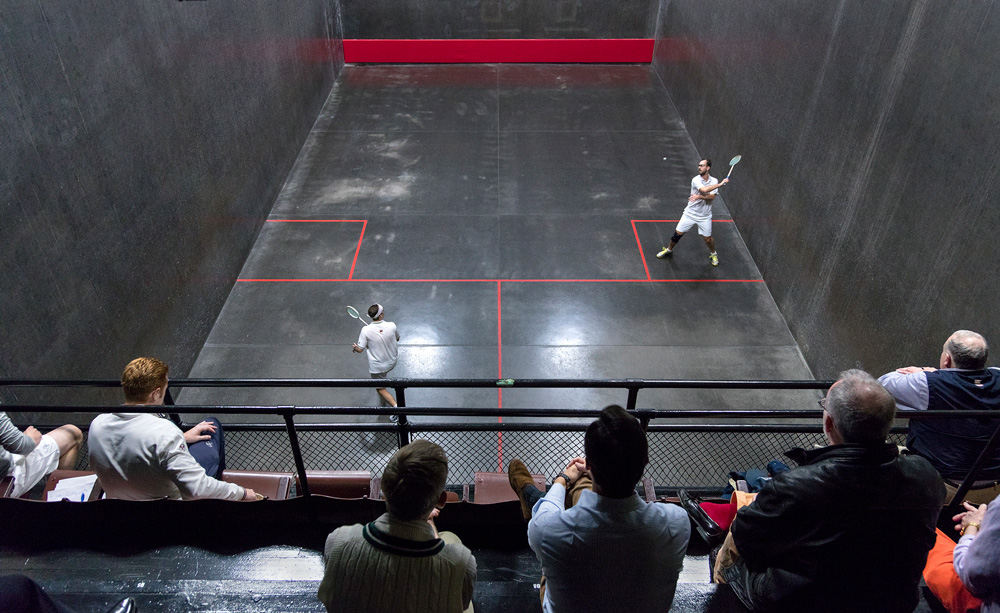
Born in the gritty confines of 18th-century debtors’ prisons in London, rackets began as a game of survival and skill, played by inmates using prison walls as their court. Its intensity soon gave rise to squash—a gentler alternative created for players to build up to the demands of rackets. While squash flourished for its accessibility and smaller wooden courts, rackets remained a fierce test of power, speed, and precision—evolving into the fastest, most demanding racquet sport in the world.
At The Racquet Club of Philadelphia, we are proud to be home to what many consider the world’s finest rackets court. Built by the renowned Bickley Brothers, master court builders from England, our rackets court is a masterpiece of craftsmanship and engineering.
The high, imposing walls, meticulously constructed from durable stone and plaster, create an unforgiving arena where speed, strategy, and precision are paramount. Players wield solid wooden racquets, expertly crafted for control and durability, to strike a small, seamed cloth-covered gutta-percha ball—capable of reaching speeds up to 180 mph.
Whether you’re mastering the basics or competing at the sport’s highest level, RCOP offers a rare opportunity to engage with a game steeped in history and fueled by adrenaline.


Squash
The Ultimate Test of Agility and Endurance
As the birthplace of doubles squash, The Racquet Club of Philadelphia holds a central place in the city’s rich squash legacy. Known as a major squash hub, Philadelphia boasts a vibrant and competitive squash culture—and at RCOP, that energy thrives every day. From 2000 to 2006, the club was proud to host the U.S. Squash Hall of Fame, further solidifying its role as a cornerstone of American squash.
Our facility includes one doubles court and six singles courts, making the club a hub for players of all levels.
From casual matches to professional competition, the club offers a dynamic, inclusive environment where competitive spirit thrives.
Our pro shop is renowned as the best in the city for setting up matches tailored to every skill level. Whether you’re new to the game or an elite competitor, our expert staff makes it easy to find the right playing partners and foster a supportive, competitive environment.
Our Legacy, Your Stories
Every moment at the Racquet Club is a continuation of a legacy that has shaped the history of sports in Philadelphia. Whether you’re stepping onto a historic court, gathering with friends over dinner, or celebrating life’s milestones, you’re becoming part of a tradition that has endured for over 130 years.